Understanding the causes of oral malodor through measurement values
What this tool helps you understand
Review test results numerically
View Oral Chroma's three gas values in an easy-to-read chart
Identify likely causes
Review the likely direction of causes from tongue, gums, dryness, restorations, and nasal/throat conditions
Confirm your improvement plan
We summarize the primary plan and daily care recommendations starting today
Confirm retest timing
Check when to retest under the same conditions and review a summary record
Today's Oral Chroma Results
This assessment is a guideline based on clinic reference values. Diagnosis is made by combining test values, oral condition, and patient interview.
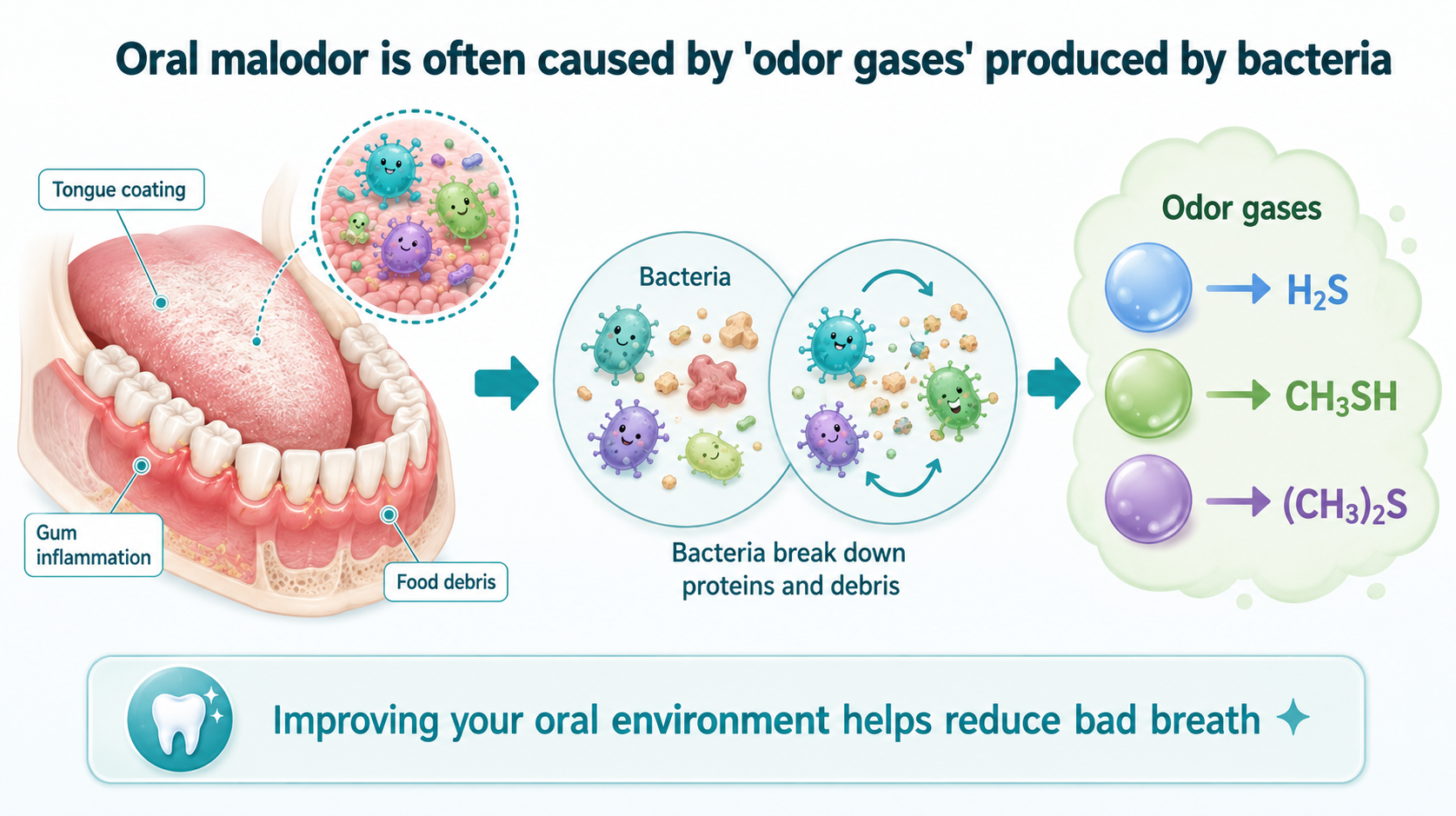
The most prominent gas indicates the likely direction of the cause
H₂SHydrogen Sulfide
Produced by bacteria in tongue coating
Sulfurous odor
- Strongly linked to tongue coating — White deposits on the tongue surface are the main source
- Increases with oral dryness — Saliva's cleansing and antimicrobial action weakens
- Often worse upon waking and when fasting — Increases during periods of reduced saliva
- Increases when stress reduces saliva — Influenced by the autonomic nervous system
- Closely related to tongue cleaning habits — Changes with frequency and method of cleaning
Tongue deposits are the raw material for odor gases. Gentle tongue cleaning and maintaining saliva flow are the cornerstones of management.
CH₃SHMethyl Mercaptan
Produced by bacteria in inflamed and bleeding areas within periodontal pockets
Odor associated with gum inflammation
- Strongly linked to periodontal disease — Inflammation of periodontal tissue is the source
- Increases with bleeding and deep pockets — More noticeable with greater inflammation
- Associated with a putrid odor — A reference for characteristic odor type
- Linked to calculus and gingival swelling — Tend to become breeding grounds for bacteria
- Filling and crown margins also contribute — Check areas where deposits accumulate
Gum inflammation and bleeding are the raw material for bacteria. Periodontal basic treatment and reviewing self-care are central to management.
(CH₃)₂SDimethyl Sulfide
Also check extra-oral influences from nasal, throat, and general health conditions
Odor requiring extra-oral cause evaluation
- Extra-oral influences also checked — Nasal, throat, and general health are also reviewed
- Nasal/throat symptoms, health status, medications also checked — Assess post-nasal drip and dryness
- Reviewed in combination with intraoral causes — Comprehensive assessment
- Association with post-nasal drip and congestion also checked — Influence of deep nasal odor
- Identifying bothersome situations and times is also important — Helps clarify lifestyle context
In addition to intraoral conditions, nasal, throat, general health, and medications are checked as needed.
Most likely cause based on today's results
Enter values on Page 2 to display the most likely cause type here.
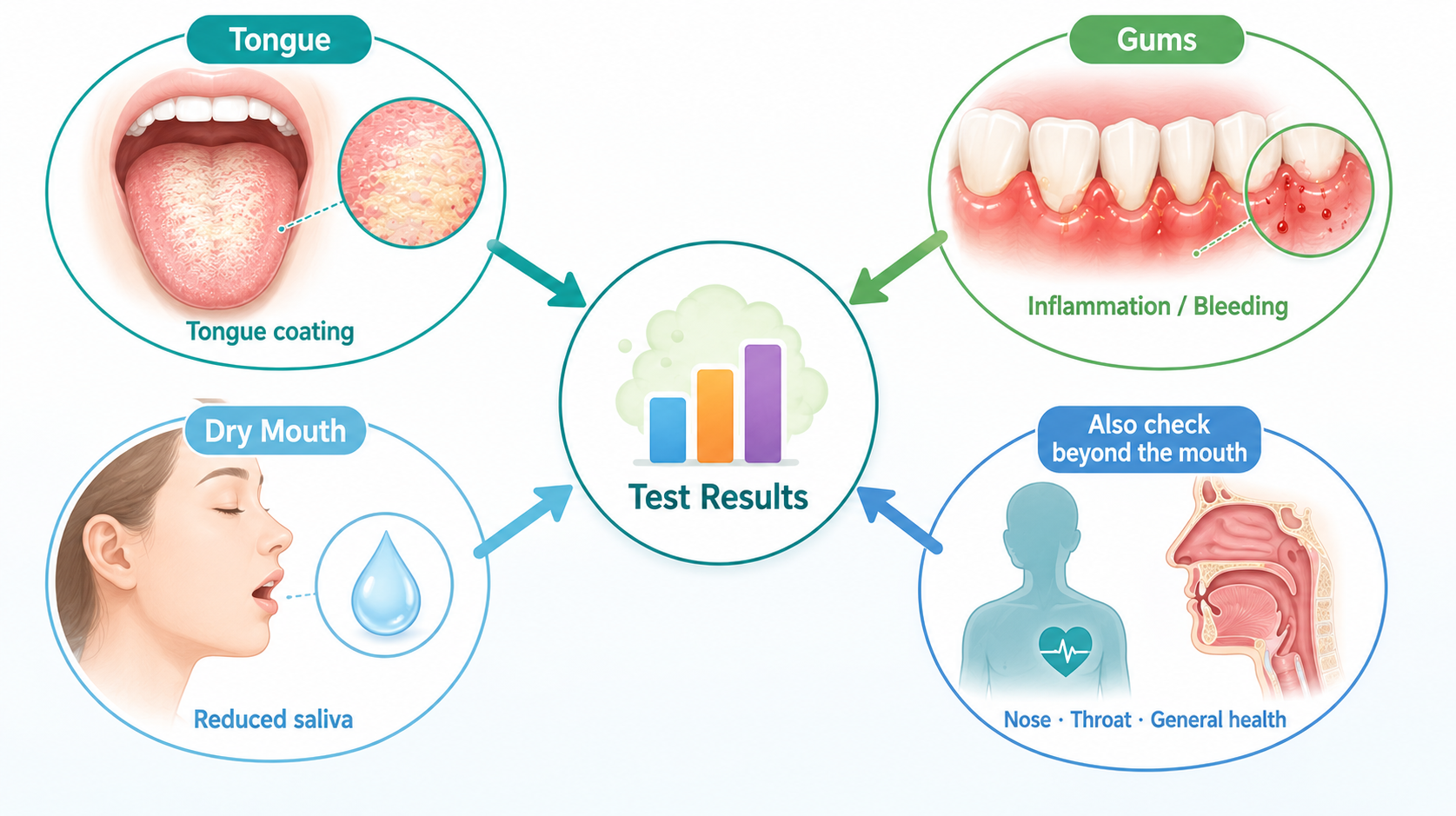
Overview of possible cause types
Tongue Coating / Dry Mouth Type
Type where tongue deposits and oral dryness tend to be involved
Periodontal / Gum Inflammation Type
Type where gum inflammation and periodontal pockets tend to be involved
Tongue + Periodontal Combined Type
Type where both tongue deposits and gum inflammation tend to be involved
Extra-oral Factors to Check Type
Type requiring review of nasal/throat symptoms, general health, and medications
Combined Type
Type where multiple factors may be overlapping
Low Values Type
Strongly elevated odor gases are not prominent; approach varies by level of concern
This assessment is a guideline based on clinic reference values. Diagnosis is made by combining test values, oral condition, and patient interview.
Review values alongside oral condition
Your Improvement Plan Starting Today
Enter values on Page 2 and check findings on Page 5 to display your improvement plan.
Why Use Support Care Products?
🦷Why use support care?
When deposits or dryness are present in the mouth, odor-causing conditions can develop more easily.
- There are areas a toothbrush cannot easily reach
- Deposits may also remain around the tongue and gums
- Dryness makes the oral environment more prone to imbalance
- Combining daily care routines makes it easier to maintain the environment
Support care products are used alongside daily cleaning to help maintain the oral environment.
💧Role of Poic Water (Mouth Rinse)
Prepare the mouth before cleaning for easier care
Poic Water is used as a rinse before brushing to prepare the mouth and make tooth brushing and tongue care easier.
- Prepares the entire mouth before cleaning
- Helps condition the surface of tongue coating and plaque
- Easy to combine with brushing, interdental cleaning, and tongue care
- Not intended to mask odors
Especially recommended for: Those with heavy tongue coating / prone to dry mouth / bothered by morning odor / undergoing periodontal treatment
This product alone will not resolve the condition. Use in combination with brushing, interdental cleaning, and gentle tongue care.
🌱Role of Probiotic Tablets
Use after cleaning to help balance the oral environment
Probiotic tablets are used as a supplement to help balance the oral flora. Consistent daily use is important.
- Using after cleaning makes it easier to support the oral environment
- Important to use as a habit rather than a one-time fix
- Aims to create an environment where odor-causing deposits are less likely to remain
Especially recommended for: Those who want to stabilize their oral environment
Tablets alone will not eliminate oral malodor. Use in combination with periodontal treatment, oral hygiene instruction, and tongue care.
📋Recommended routine
First prepare the mouth, then remove deposits, and finally support the balance of the oral environment.
No single product should be used alone — consistent use combined with daily cleaning is what matters.
Print for the patient or save as a file.
This tool is designed so that no personal information is entered. Follow clinic policy when saving or sharing.
Today's Oral Malodor Examination Summary
This record is not about masking odor — it is about building an oral environment where odor gases are less likely to form.
① Today's test results
| Gas | Today's result | Likely related cause | Reference |
|---|
② Most likely cause type today
This is not a definitive conclusion based on test values alone — it is confirmed together with the intraoral condition and patient interview.
③ Level of concern (malodor)
④ Oral findings today
⑤ Improvement plan starting today
Support care
The mouth rinse and probiotic tablets are not for masking odor — they are used as daily supplements to help maintain the oral environment.
- Poic Water: Rinse before brushing to prepare the mouth for easier cleaning
- Probiotic tablets: Support oral flora balance
Support care routine: ① Rinse → ② Clean (brush / interdental / tongue) → ③ Probiotic tablet → ④ Retest under same conditions
⑥ Daily care starting today
⑦ Avoid overdoing it
Gentle and consistent daily care is more important than vigorous or frequent cleaning.
- Do not scrub the tongue hard
- Do not clean the tongue more than once a day
- If you experience pain or bleeding, do not force yourself to continue
- Do not try to mask odor with rinses or tablets alone
- If values are low, do not repeat self-checks excessively
⑧ What to check next time
| Retest guideline | — |
|---|---|
| What to observe next | Odor gas values / Gum bleeding / Tongue coating / Dryness / Cleaning status |
| Note | Measure under the same conditions as much as possible |
⑨ Next appointment
Next scheduled check: ______/____/____
What to check next time:
Oral malodor treatment is not about masking odors. It is about building an oral environment where odor gases are less likely to form. Let's work together to improve, guided by your test values and oral condition.
This assessment is a guideline based on clinic reference values. Diagnosis is made by combining test values, oral condition, and patient interview.